Showing posts with label Safety. Show all posts

Saturday, October 8, 2016

Purifying Water During an Emergency

This story is posted on the exact date and time that a tree fell on our home during hurricane Matthew. I decided on that day, that emergency preparations should start now and be ongoing. One never knows when a disaster will strike.

Purifying Water During an Emergency

The treatments described below work only to remove bacteria or viruses from water. If you suspect the water is unsafe because of chemicals, oils, poisonous substances, sewage or other contaminants, do not drink the water. Don't drink water that is dark colored, has an odor or contains solid materials.

Storing Water Safely
  • The best source of drinking water during an emergency is water you have stored with your emergency supplies.
  • Store one gallon of water per person per day--enough for at least three days.
  • Store-bought, factory-sealed bottled water is best. Check for an expiration date and replace as needed. 
  • If you choose to fill your own water containers:
  • Collect the water from a safe supply.
  • Store water in thoroughly washed plastic containers such as soft drink bottles. You can also purchase food-grade plastic buckets or drums.
  • Seal water containers tightly, label with date, and store in a cool, dark place.
  • Replace water every six months.
  • Never reuse a container that held toxic substances such as pesticides, chemicals or oil.

Purifying By Boiling

If your tap water is unsafe, boiling is the best method to kill disease-causing organisms.

If tap water is unavailable, the following may be considered as potential water sources. Water taken from these sources should be boiled before drinking.:
  • Rainwater
  • Lakes
  • Rivers and streams
  • Natural springs
  • Ponds
Caution: Many Chemical Pollutants Will Not Be Removed By Boiling.
  • Cloudy water should be filtered before boiling. Filter cloudy water using coffee filters, paper towels, cheesecloth or a cotton plug in a funnel. 
  • Bring the water to a rolling boil for at least one full minute.
  • Let the water cool before drinking.
Purifying By Adding Liquid Chlorine Bleach

Add two drops of household bleach per gallon to maintain water quality while in storage.

Place the water in a clean container. Add the amount of bleach according to the table below.

Mix thoroughly and let stand for at least 60 minutes before drinking.

Treating Water With Household Bleach Containing 5.25-8.25 Percent Chlorine

Volume of Water to be Treated Bleach Solution to Add

For 1 quart (0.946 L) of water, use 5 drops (0.25 mL) of bleach.

For 1/2 gallon (1.89 L) of water, use 10 drops (0.5 mL) of bleach.

For 1 gallon (3.79 L) of water, use 1/4 teaspoon (1.23 mL) of bleach.

For 5 gallons (18.9 L) of water, use 1 teaspoon (4.92 mL) of bleach.

For 10 gallons (37.9 L) of water, use 2 teaspoons (9.86 mL) of bleach.
  • Treat water by adding liquid household bleach, such as Clorox or Purex.
  • Household bleach is typically between 5.25 percent and 8.25 percent chlorine. Read the label.
  • Avoid using bleaches that contain perfumes, dyes and other additives. Be sure to read the label.
  • Cloudy water should be filtered before adding bleach.
Caution: Bleach will not kill some disease-causing organisms commonly found in surface water. Bleach will not remove chemical pollutants.

Source: Washington State Department of Health, 2013, Link here.

Tuesday, April 7, 2015

Working With Prison Inmates

I've been working for Florida Department of Corrections since October 2012, in Transition, Security and now Education. Following, are some thoughts on what I have experienced. My writing may seem to soften or humanize the inmates in the prison setting, but I am looking at the big picture as I write this. Some of the inmates have done some truly horrific things, all of them some really bad things, or they wouldn't be in prison!   Just last week, one of my best Inmate Teaching Assistants put himself into Protective Management because he got beat up and his watch stolen. This past weekend three inmates from my institution went to the hospital due to stabbing related incidents.  This isn't secret news I'm sharing, it was on the front page of the Daytona papers.

Also be sure, I intend no disrespect to the officers, or administration in this post.  They do the best that they can to protect all inmates, security, civilian staff and the public. The image above is from California (see photo credit below, used with permission), but it is a likeness of my institution.

Working With Prison Inmates
Working in the prison system has caused me to realize
the value of the individual in God’s eyes.
The rough exterior of the inmates is usually a facade,
to mask the guilt, pain and shame of crimes they've committed.
If one looks beyond the sea of blue clothing
and into the eyes of the individuals,
you’ll see they may have been acquitted as criminals by God,
but not by the state and usually not by themselves.

Re-Entry, transition and betterment are the clichés of the system,
but it does not address the needs of the victims;
not excluding the scars left on the families of those incarcerated,
when their sons attempt to become exonerated, by fulfilling their obligation to the courts.

It is our job as corrections staff to uphold safety and order,
while at the same time maintain a border of impartiality and professionalism.
Care, but not too much. Custody, but doing so humanely. Control, but not degrading.
All the time crusading, for maintaining the dignity of the individual,
the organization we represent, and the One who called us to this important position.

Photo Credit Link Many thanks to the CA Department of Corrections.. 

This post is written only from my opinion and experience.  In no way does it express the policies, procedures and management policies of the Florida Department of Corrections or the State of Florida.

Monday, March 23, 2015

Now Teaching Family Classes in Firearms Safety

Photo Credit: Michigan State University 4-H Shooting Sports
I am now teaching Family Firearms Safety for donations only.  A typical class of this quality and quantity of information by a Certified Instructor is about $75 per person.

If you have firearms in your home, and don't know much about them, this class is for you! If you cannot afford a class?  No worries.  I can assist you with no charge or agreeable terms.

If you're interested, get a hold of me.  My email address is guskoerner@gmail.com.  I also teach by distance learning (Skype). Typically I will come to your home, or you to mine and talk about family firearms safety.  I have youth appropriate DVD's as well. This class is centered on age appropriate, hands-on materials for the children of your home AND satisfies the Florida requirement for the Concealed Weapons Permit.

This is how it works.  When firearms are in the classroom, they are always locked, or otherwise inoperable, and there is NEVER any ammunition present; the cardinal rule of firearms instruction.  I am successfully security screened by the Florida Department of Law Enforcement, Florida Department of Corrections and Brevard Public Schools and can show credentials upon introduction.  I am a former 4-H Youth Development Agent and Instructor for the Florida Fish and Wildlife Conservation (Game) Commission.

This course description below is typical, but I also teach rifle, black powder firearms and non-certified archery and shotgun.  Below is a description of one of the courses I teach.

NRA First Steps Pistol Course Description, 3 hours (1.5 hrs class + 1.5 hrs range)

FIRST stands for “Firearm Instruction, Responsibility, and Safety Training”, a program the NRA developed to meet the need for a firearms orientation program for new gun purchasers. This FIRST Steps program is a basic courses abbreviated to the most fundamental shooting skills, and the specifics of a particular model of pistol.

This course, because of its narrow focus, can be completed as quickly as three hours. Students will get quick practical lessons on the safe use, cleaning, and storage of their pistol. The practical exercise covers a single pistol shooting position.

Course Goal
“To provide beginning shooters with an introduction to the knowledge, skills, and attitude necessary to own and use a specific pistol model safely.”

NRA FIRST Steps Pistol Orientation Lesson Plans
1.Introduction to Pistol Safety, Parts, and Operation
2.Introduction to Ammunition and the Fundamentals of Pistol Shooting
3.Introduction to Pistol Shooting from the Benchrest Position
4.Introduction to Pistol Cleaning, Storage, and Training Opportunities

Prerequisites
The are no prerequisites for taking this course, and the material is accessible to appropriately supervised mature children.

Tuesday, September 9, 2014

A Cliche Saved My Life

Most people dislike cliches because of their nature; trite, over used words and phrases. But one for me stands out, which is “go with the flow”. Stay with me, because that phrase literally and figuratively have saved my life. Throughout my career employers have used this phrase or its related forms, such as “adapt”, “embrace the change” and “this is the new normal” to express major changes in an organization, usually due to management turnover or budget cuts.

I gotta tell you a story about how this “adaptation” literally saved my life. My buddy Jim (pictured right) taught me how to fly fish. So once I felt pretty confident in my gear and skills, I took off to a part of the Little Bear River in southern Idaho to catch some fish. I think it was late June, when the water is still frigid cold, but the mountain run off has slowed down enough to see the rocks in the shallow places and near shore.

I got my gear together the night before, tackle, waders, cooler, etc. and the next morning I stopped by Burger King and picked up two 99 cent whoppers, one for lunch and one for on the way home and tucked them under the seat of my car. I arrived at the rivers edge about 11am and the call of the river beckoned me to hurry, yet I was enjoying the view of the mountains and greenery of my surroundings.

As usual, one hardly ever gets a bite on their first cast so I tried and tried, moving up and down the shoreline, moving out into the deeper water current as I went. Then suddenly I took one step too far into a drop-off that went over my head. My waders instantly filled with ice cold water and I found myself being sucked in deeper and faster! It was at that instant that I thought “go with the flow”. Thinking back, I consider it now one of those “God moments” when panic left me and was replaced by peace and rational thought. So instead of fighting the ice cold current, I raised my rod over my head and let the river push me downstream which naturally led me to a shallow bend where I was able to walk out and compose myself.

If I had fought the current and tried to immediately get to high ground I might have perished. But, instead I was willing to go a bit out of my way following the flow for a hundred feet or so and come out just fine.

So what’s the moral of the story? #1, don’t fish alone in the wilderness where nobody knows your whereabouts, and #2, the longer way, or new, different way than you insist upon may be a better way for you to go. Counsel with family, friends, those wiser, and especially God before we make up our mind on how things have to be, “God’s ways are not our ways…” and situations may turn out better than we expected.

“For my thoughts are not your thoughts, neither are your ways my ways,” declares the Lord.  “As the heavens are higher than the earth, so are my ways higher than your ways and my thoughts than your thoughts.  - Isaiah 55:8-9 (NIV)


Monday, February 3, 2014

OSHA Respiratory Standards

Found this today.

Occupational Safety and Health Standards, Personal Protective Equipment, Respiratory Protection, Part number 1910.


An excerpt...

Permissible practice.

1910.134(a)(1)

In the control of those occupational diseases caused by breathing air contaminated with harmful dusts, fogs, fumes, mists, gases, smokes, sprays, or vapors, the primary objective shall be to prevent atmospheric contamination. This shall be accomplished as far as feasible by accepted engineering control measures (for example, enclosure or confinement of the operation, general and local ventilation, and substitution of less toxic materials). When effective engineering controls are not feasible, or while they are being instituted, appropriate respirators shall be used pursuant to this section.

Thursday, February 28, 2013

How to get a Concealed Weapons Permit in Florida.


Even though this article is written for Floridians, the process and points I make are very similar in other states.  What ever your reasons are for getting a Concealed Weapons Permit (CWP) are your own, but more and more I see people getting one because our current political climate is making people think this right will be taken away.  This is a right that law abiding citizens have, and just because you carry a concealed weapon, does not mean you have the right to use it.  The laws around this are very strict, and somewhat complicated.  Educate yourself.

In Florida CWP licensing is a Florida Department of Agriculture responsibility.  Normally I like to hyperlink the website, but since this has been changing lately I'll point you in the right direction.  The site is http://www.FreshFromFlorida.com/, and you need to go to the Division of Licensing, where all the forms and instructions can be downloaded.  They used to mail out packets, but I think that's been discontinued.  Here is a condensed version of the process. 

Fees to expect:
License fee: $70
Fingerprint fees: $42 (may be less)
Passport photo: $10
Training fees: Free to $150 depending on type

1. Read the Chapter 790, of the Florida Statutes and see if it is for you. alternate link here
2. Download the application and instructions here.  The application must be signed in front of a Notary.
3. Get your finger prints taken at a local police or sheriff's office.  If you submit the traditional fingerprint card with your application, it will cost you $42 more.  If you have law enforcement electronically send in your prints, they will charge you a fee, but it is less and will speed up the process for you.  The overall cost of this is about the same, but it is a real time saver.
4. Have your passport photo taken, you will need to submit this with the application.  Be sure to read the application instructions about this.
5. You will need to submit a "training certificate".  The rest of this story addresses this training requirement.

I (and others) teach many firearms classes, but the two most people are interested in are FWC Hunter Safety, held normally once a month (8 to 16 hours), NRA First Steps Pistol Orientation (3-4 hours) and NRA Basic Pistol (8-10 hours).  The only way you can have a course last only an hour or two is if you come in with previous, near expert knowledge.

The Florida CWP requirement for training is "You must be able to demonstrate competency with a firearm.", which is a very broad statement, and often misinterpreted.  Some less than honest instructors are willing to take your money under the guise of Concealed Weapons Permit Training.  Buyer beware, know the requirement.  Below is text copied from FL DACS - Question 6, Application Instructions:

Florida law requires you to submit proof of competency with a firearm in order to qualify for a concealed weapon license. A copy of a CERTIFICATE OF COMPLETION or similar document from any of the following courses or classes is acceptable:

• any hunter education or hunter safety course approved by the Florida Fish and Wildlife Conservation Commission or a similar agency in another state;
• any National Rifle Association firearms safety or training course;
• any firearms safety or training course or class available to the general public offered by a law enforcement agency, junior college, college, or private or public institution or organization or firearms training school, utilizing instructors certified by the National Rifle Association, the Criminal Justice Standards and Training Commission, or the Department of Agriculture and Consumer Services;
• any law enforcement firearms safety or training course or class offered for security officers, investigators, special deputies, or any division or subdivision of law enforcement or security enforcement;
• any firearms training or safety course or class conducted by a state-certified instructor or by an instructor certified by the National Rifle Association.

The copy of the training certificate/document must be clear and legible. The certificate/document must include your name, your instructor’s name, your instructor’s qualifications/credentials (National Rifle Association instructor, law enforcement firearms instructor, Class “K” Firearms Instructor licensed by the State of Florida, etc.), and your instructor’s license/certification number.
---------------------
FL FWC Hunter Safety classes can be found here.
NRA Training Programs can be found here.
NRA Courses near you can be found here.

Hunter Safety is about a 12 hour class and $10 (sometimes free) and my NRA class is 3 hours and $60 per person.  I have significant family discounts.  There are many other good classes that can qualify you for your application, but the important thing is that you feel confident in safe firearms handling, and you are aware of the laws that apply to your new permit.  Neither of my classes deal with CWP laws to a significant degree, because FWC nor the NRA wish to carry that liability of giving legal advice.  To get the advice you need for legal purposes, read the law and consult law enforcement and / or an attorney.

Final note - I hope this process will prompt you to practice your firearm safety and skills for a long time, and it will not be something you get and then forget.  Use this opportunity to meet people at a local shooting range or gun club.  I think you'll find shooting sports and the people you meet to be fun and rewarding.  Also, when you go through this process share it with your family, especially your children.

Friday, October 19, 2012

Maintaining Equipment in a Youth Shooting Sports Club

I speak here specifically about archery, but the same is true of all similar youth shooting sports programs, so shotgunners and muzzle loaders, please read on...

As a youth archery instructor, one of the greatest challenges is to make sure the young people always have ready quality, safe equipment.  On the surface it doesn't seem like it would be that hard, but when you consider all the things used in archery, it gets to be quite a challenge.  One archer alone will use a bow, that has a string, multiple arrows that will have a quiver, the safety equipment of an arm guard, finger tab or glove, and will shoot at a target that has paper held on by pins, at a fixed distance that is laid out on a range with safety lines, perimeter rope and signs.  Right there I named about seven items, now multiply that by 10 to 20 shooters in a club.  It takes a virtual warehouse to store all these things, and each of them are wearing out, if only just a little bit, one practice after another.

It can be justified to have a youth shooter and a dedicated parent to take charge of all the equipment, because if not, it soon becomes more than a club leader can handle under the job description of a volunteer archery club leader.  Let's for a minute talk about cost.

Is your 4-H, Scout or JOAD program free of charge to the children?  It better not be.  A free program cannot survive, plus children must learn to pay to play.  Where in your adult life can you have a free hobby? It is sending the wrong message of value when we run a program that is free of charge.  It says to the participant that some sugar-daddy person or organization is providing a charity program, which gives an unjustified sense of entitlement, or it says that your program is not worth much.  A quality program can have maintained equipment if even a token amount is charged, say $3.00 to $4.00 per shoot.  One quality archery target is about $70.  Nowadays virtually every family can come up with that fee, which is about the same cost as candy or two bottled sodas.  When I was managing a youth archery program a few years ago, I did have some kids that couldn't afford that.  I worked out a deal with them to bring in aluminium cans at every shoot, and provided a barrel to put them in. Did that pay for the wear and tear on the equipment they were using?  No, but it helped, and gave the children a sense of ownership in the activity, and that even by collecting aluminum cans they were paying their own way for the enjoyment of shooting.


If you are leading a youth shooting sports program, God bless you and thank you for your service.  Every kid needs something like this to learn and reinforce safety, leadership, responsibility and build their self worth.  Please remember though that keeping equipment ready, properly cared for and safe will make the program run smooth and will indirectly teach and remind us all to be good stewards over the things we have.

In researching this topic, I ran into a Hunt Chat forum post by a fellow archer and Dad, in Wisconsin with the username Rancid Crabtree.  In his very detailed July 2008 post My Latest Longbow, he shows how to make a longbow bow, bow stringer, inset medallion and tip guard (see photo), in a way that is very easy to understand.  Check it out!

Friday, October 12, 2012

Are you a Safe Hunter for life?

Last weekend I helped teach Florida Hunter Safety at the Titusville Rifle and Pistol Club in Mims, FL, my local gun club.  It was a great class as usual, with about 38 students.  We spend time in the classroom reviewing the different parts of the course such as Safe Gun Handling, Ammunition Types and Wildlife Conservation.  We also get to hear about the Florida Hunting Regulations from a real-live Game Officer.  That part is pretty cool. Finally before the students get their card, they have to show their safety skills with a firearm.  Last weekend we shot .22 rifles and shotguns.  Sometimes we shoot muzzle loaders and bows.  If the students can shoot safely and score 80 out of 100 on the exam, they pass.

It dawned on me a little while back that the Florida Hunter Safety Certification cards have no expiration date!  That means that if I certify a young person, the youngest I've had is age 8, that certification will be good FOREVER.  All my other certifications including those I possess as an instructor, and even a Drivers License all expire within three to five years.  When that time rolls around, I have to take a written or practical exam and sometimes both!

After I calmed down from the shock of a person never having to show their hunting safety skills ever again, I felt a very heavy burden as an instructor.  I realized that every word out of my mouth should be carefully chosen, and I should pay close attention as an educator to make sure the students realize the great responsibility they have.  I also have started to encourage the students to participate in other courses and programs to sharpen their skills, and reinforce the safety knowledge they possess.  I urge parents to take their kids out regularly and practice safe skills.

In my last class, I called up a 12 year old young man and told him, "Bud in 50 years you'll be 62 and still have the same hunter safety certification that you get today, and I'll be long gone.  Make a decision now to be a safe hunter for the rest of your life."  He gulped and said okay.

If you're an instructor, keep this all in mind next time you teach.  If you're a parent, always always always be an example of a safe, ethical hunter to your children and fellow hunters.  If you're a kid or a teen, make a commitment while you're young to be safe forever, and encourage others to do the same.  Be safe, and take the time to enjoy the incredible privilege of hunting we've been given.

Wednesday, May 23, 2012

Which NRA Basic Pistol class is for you?


Are you looking to purchase a new pistol? Would you like to learn about how to safely use, store, and clean a pistol? Are you interested in getting a concealed carry permit?  Perhaps you are the spouse of a gun enthusiast, or a parent and just want to make sure you can safely handle a firearm while others are gone.  The latter makes up the majority of my students.

If you answered yes to any of these questions, consider taking an NRA Basic Pistol or FIRST (Firearms Instruction, Responsibility, and Safety Training) Steps Pistol course, taught by an NRA Certified Pistol Instructor.

Follow are the similarities and differences between the two courses to help you decide which is the best choice for you.

Both the Basic Pistol and the FIRST Steps courses are introductory in nature and present the same type of material. In each class, instructors cover the NRA’s gun safety rules, pistol nomenclature and operation, ammunition, shooting fundamentals, cleaning, range rules, and continued opportunities for skill development. The format of the classes is very similar, beginning with a classroom portion before heading to the range for live-fire shooting exercises.

Basic Pistol is a 10-hour course where students learn about both semi-automatic pistols and revolvers. FIRST Steps is only 3-4 hours long, and focuses on only one pistol action type (semi-automatic OR revolver, not both) and model (Beretta 96, etc). When choosing a course, make sure you take several factors into consideration – such as the action type of the gun you own or plan to purchase and your experience handling and shooting pistols.  If you are looking to learn about handling both semi-automatic pistols and revolvers, you may want to take the Basic Pistol course. If you already own a semi-automatic and want to learn more about your gun, then the FIRST Steps Pistol course may be right for you.

If you are still unsure about what class to take, ask the NRA Certified Instructor teaching the course to help you decide, or contact me.   Most instructors are very knowledgeable and eager to assist you. To get started, find a course in your area or learn more about NRA’s firearms training courses!

Monday, May 7, 2012

How young is too young to take a child shooting?

In the Florida 4-H Shooting Sports program, which is part of the National 4-H Shooting Sports program, a committee had determined that shooting sports begins for a child at 8 years old.  They have set the following guidelines, which most states have adopted:
  • Age 8-10 (4-H Juniors) are allowed to learn archery and air rifle (pellet).
  • Age 11-13 (4-H Intermediates) are allowed to learn virtually all of the rest of the shooting sports, including rifle (small bore or .22 rimfire), black powder rifles and shotguns (muzzle loading) and shotgun.
  • Age 14-18 are reserved some special privileges such as air pistol (not in Florida), but in other states they can learn high power rifle, high power pistol and crossbow.
There is a reason these guidelines have been put in place.  They weren't just concocted by some non-shooters who are trying to hold kids back.  On the contrary, the National 4-H Shooting Sports Committee who set this standard is made up of some of the finest Educator/Shooters in the country, with representation on the committee from the NRA and industry.

This past weekend I had a great time teaching my 8 year old grandson Gavin how to shoot a black powder rifle, and since it was not a 4-H program, I was okay with the laws and liabilities of the situation.  Prior to going, I was not quite sure how he would handle it.  Once or twice before I taught him the basics or air rifle handling in the backyard, so this was quite a few steps up in complexity and power.  He did very well to make a long story short, but that is because his Papa Gus helped him every step of the way, quizzing him on safety, parts and procedure the whole time.  Was I able to shoot too?  Of course I was.  Utilizing the Coach-Pupil method of teaching, I had him coach me, just as I had him - every step of the way, reinforcing his knowledge gain.  The other part that I was concerned about, and was not sure until I tried it, was using the Caldwell Lead Sled to help him make his shots.  This wonderful tool took almost all of the recoil of the gun away, but allowed him the flexibility to adjust his own sights, and shoot the gun himself.  I first learned about the Lead Sled at the 2009 Orlando SHOT Show, but they can be purchased at most stores that sell quality shooting gear.

I need to point out that even though these are the recommended ages for 4-H, they differ for other youth programs, and sometimes within the same program but state to state and county by county.  Check with your local youth leadership professional to be sure.  Some programs are more or less stringent, but I think they're about right.  No child is however too young to learn about the dangers and risks involved with guns and anything that shoots a projectile.  Kids are killed virtually every week with air rifles, airsoft and paintball guns.  They should all be respected, and every member of the household, oldest to youngest should know The 3 Always of 1) Always keep the firearm pointed in a safe direction, 2) Always keep the gun unloaded until you're ready to use it, and 3) Always keep your finger off the trigger until your sights are on the target.

There are some excellent articles and helps written on the Ages and Stages of kids.  My very first reference for this is the Univ. of Florida EDIS publications on teen development.  Another great site for this is HealthChildren.org.


Thursday, January 19, 2012

Keep your family safe by locking your guns.

Most people I know who have a gun in their home do so for the primary reason to keep their families safe.  It is unfortunate that sometimes the home becomes less safe because of that firearm.  What I mean is, that the home owner has the sense of security that they can protect themselves from an intruder, which may or may not happen.  On the other hand, that same home owner puts their family at risk by storing the gun in an unsafe manner that may be accessible to kids.


Moms and Dads, lock your guns and keep the ammunition locked separate.  For those of you who want to have the security against an intruder, ask yourself, "Am I really ready to shoot and kill another human being?".  After seriously considering all of this I concluded that most people would probably be better off by installing or upgrading a security system, leaving outdoor lighting on, buying a dog that will alert you to prowlers or all three.


Securing your firearm is not just a safe thing to do.  It's the law.  If you do not know how to lock your firearm, call any law enforcement officer or agency, gun shop or visit the National Shooting Sports Foundation, Project ChildSafe website.

Thursday, January 5, 2012

Just an air rifle?

How many kids and families do you know that got an air rifle for Christmas or have one in the house??

Those of us who teach firearms safety stress some version of the National Rifle Association, 3 Always of Guns Safety, namely 1) keep your gun pointed in a safe direction, 2) keep your gun unloaded until your ready to shoot, and 3) keep your finger off the trigger until your sights are on the target. In order for a firearms accident to occur, all three of these rules have to be broken, at the same time!

A tragic story was reported in England today:

Boy, 10, Killed With His Father's Air Gun While Playing Cowboys and Indians with His Friends
Thursday, Jan 05 2012, Swansea, England, UK
By JULIE MOULT, DailyMail.co.uk


A BOY of ten was shot dead in a game of cowboys and indians as he and a friend played with his father's airgun. Rhys Johnson was fatally wounded when the weapon went off, blasting pellets into his chest. Full story.

Photo: Rhys Johnson is pictured here with his older sister Ashleigh. By http://www.dailymail.co.uk/

Parents please keep in mind that although BB guns and Air Rifles are less powerful than their high-power counterparts, they are still not toys and can cause serious property damage and personal harm, as shown in this story.  Air rifles can be a great tool to teach young people safe handling of firearms and marksmanship with a gun that is void of recoil and designed to fit kids 6 and up, BUT they are guns.  Make sure they are treated with the same respect as any other firearm.


Wednesday, December 14, 2011

Hunting Safer Than Golf, Report Says


In a recent article by the National Shooting Sports Foundation, the trade association for the firearms industry, they released the results of their compiled safety data for 2010. Their data shows that hunting ranks third in safety when compared to 28 other recreational pursuits, including golf and many others ranging from baseball to wrestling.

"Many people have the misconception that hunting is unsafe, but the data tells a different story," said Jim Curcuruto, NSSF's director of industry research and analysis. "Comprehensive hunter education classes that emphasize the basic rules of firearm safety and a culture of hunters helping fellow hunters practice safe firearms handling in the field are responsible for this good record."

To put hunting's safety standing into perspective, compared to hunting a person is . . .
- 11 times more likely to be injured playing volleyball
- 19 times more likely to be injured snowboarding
-  25 times more likely to be injured cheerleading or bicycle riding
-  34 times more likely to be injured playing soccer or skateboarding
-  105 more times likely to be injured playing tackle football.


For the entire article, click here.

Another very interesting and related report is by the Centers of Disease Control and Prevention (CDC) and their WISQARSTM (Web-based Injury Statistics Query and Reporting System), which is an interactive database system that provides customized reports of injury-related data.  This graphic by the CDC list unintentional firearms accidents a 0.5% of unintentional fatalities compared to all other major categories of accidents.

Monday, September 19, 2011

Archery Targets "Success Close" May Be Too Close


This is to all those archery coaches out there, parents included who want their young archer to have success in making their first shots.  Being close enough to hitting the target, or perhaps even the bulls-eye means that the target needs to be at whatever safe distance is necessary for the arrow to hit its mark.  Depending on the archer, the equipment and the target, a commonly used distance of 15 feet or 5 yards may in fact be posing a danger to the shooter and others on the range.


A close call! - Last night on the archery range, one of our young shooters shot a 10 pound draw weight bow, into a commonly used archery target rated for bows and target arrows up to 40 pound draw weight.  The arrow bounced out.  It didn't just bounce and fall, it bounced with such force that it came all the way back to the shooting line and was caught by an instructor over the heads of other shooters and spectators!  If that arrow would have struck someone, it wouldn't have killed them, but it could have certainly penetrated the skin or other soft tissue.


The target that was being used was too dense for the arrows being shot, and was made of closed cell foam, which is common in the industry.  A much safer choice in this circumstance would have been a target made of open cell foam.  For those who do not know the difference, open cell foam is commonly seen in the white $2 insulated coolers, and closed cell foam is used in camping mattress pads and door insulation.


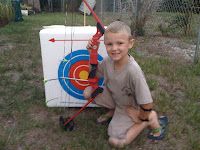
Gavin W. proud of his first shot!
The bow and target pictured right are a great combination for a young archer's first shot.  Gavin is holding a Matthew's Genesis bow, set at a 10 lb. draw weight, standing in front of a Drew Foam archery target made of open cell foam, which is covered with bulls-eye faced plastic for immediate use and weather proofing.


In a well rounded archery program the equipment will match the skill levels of the students. Having both open and closed cell targets, and alternative bag targets will allow for shooters with light and heavy equipment, at different skill levels have a safe and rewarding experience.


Mr. Gus

Wednesday, February 16, 2011

The 3 Always of Gun Safety could have prevented a local tragedy

Charges pondered in shooting death of 13-year-old in Cocoa (Florida)
Florida Today, Feb. 15, 2010, written by: John A. Torres


"It is uncertain whether a 25-year-old man who police said accidentally shot and killed a 13-year-old girl during the weekend will face charges.

Investigators with the Brevard County Sheriff's Office said Dustin Adkins accidentally fired his handgun Saturday evening through his bedroom door during a family barbecue.

Neighbor Kasey Canada, 13, was in the kitchen when the bullet struck her in the back. The Clearlake Middle student was taken to the hospital where she later died."  For the entire story click here.

This is a tragic story that could have been prevented.  The National Rifle Association teaches us that the three fundamental rules for safe gun handling are:
1. ALWAYS keep the gun pointed in a safe direction.
2. ALWAYS keep your finger off the trigger until ready to shoot.
3. ALWAYS keep the gun unloaded until ready to use.

In order for someone to be accidently shot, all three, not just one of these rules below need to be broken. Please do your part in following them, and teaching this responsibility to others.  Also see: A Parents Guide To Gun Safety, and visit the site of The Eddie Eagle Safety Program.  Thanks to all instructors, leaders and parents who are taking proactive steps in teaching others how to prevent firearms accidents.

Tuesday, February 15, 2011

Why we never say the "W Word" in recreational shooting sports.

If you have ever participated in a shooting education class hosted by Scouts, 4-H, the NRA or similar orgaizations, you might have heard someone getting scolded for using "the W-Word" or Weapon (oops, I said it!).  Sorry.  I've heard the wrath of an instructor several times, because I'm in that line of work, I've been chewed out myself in the early days and I've had to call a few others out in my own classes.  This is why...

The word weapon defined is any instrument or device for use in attack or defense in combat, fighting, or war, as a sword, rifle, or cannon; or anything used against an opponent, adversary, or victim.

Is that why we are teaching youth and youth volunteers shooting sports?  I think not.  We are teaching kids and the community safe, recreational shooting to build marksmanship skills, discipline and responsibility in the use of a firearm.  We leave weapon training to law enforcement and our military service members - where that word is appropriate.  It also has perfectly reasonable context in conversations about home and self protection.

The next time you're in a training situation, either as the coach or the student, I encourage each of us to call the firearm just that, a firearm or even better call it by its name.  Use the specific terms for them such as rifle, pistol, handgun, shotgun, etc.  That's more appropriate, and it won't leave images in the mind of your students of taking someone's life.

Tuesday, February 1, 2011

County Extension Teaches Hunter Safety


The University of FL / IFAS / Brevard County Extension in partnership with the Florida Fish and Wildlife Conservation Commission (FWC) will be teaching local Hunter Safety Classes, monthly, at the Titusville Rifle and Pistol Club in Mims, FL.

Extension has a rich history teaching and consulting in agriculture, family and consumer science, horticulture, and natural resource management for the home owner and industry. The Brevard 4-H program has had youth shooting sports since the early 1990’s, so reaching out to the community with Hunter Safety education is a natural progression.

The Hunter Safety curriculum being used is written by FWC. The primarily taught Internet-based Hunter Safety Course allows the student to learn a majority of the knowledge portion of the course via distance learning. The remainder of the course is covered in a 4-hour classroom setting, written test and a 3-hour range test. Extension’s involvement with Hunter Safety Education allows students to learn of similar programs currently taught by Extension, and provides additional opportunities for families to participate in 4-H shooting sports and to hone their skills as safe outdoors men and women, while promoting home firearm safety. For more information and dates and times, please call Gus Koerner at 321-633-1702 x229.

Monday, September 8, 2008

The Story of My New Hatband

My friend Al, who is also one of my colleagues in muzzleloading and archery, gave me a really nice hat a few weeks ago. It is a black felt, wide brimmed, low crowned head piece just like one they would have worn back n the 19th century. Even though it’s a nice hat, it’s kind of plain so I have been considering how to dress it up.

photo credit: Wikipedia
Last weekend at the gun club during a training session break, one of my teenage female students stumbled across a Florida Pigmy Rattler (dusky pigmy rattlesnake) sunning himself in the walkway. She stopped, backed up to a safe distance - surprisingly not screaming, then she called a few of the male adult leaders over to do something about this pesky little snake. Pigmy Rattlers rarely get longer than two feet long, but their venom is still very toxic, enough to ruin your day and potentially cause a limb or digit to be amputated or I suppose it could even cause death. The adult leaders being brave sorts, found a long long stick and proceeded to harass the snake, poking it, so as to make it strike. After it struck, they proceeded to dispatch the serpent by mangling its head until it moved no more.

As one of the leaders carried the limp, lifeless snake away to dump it in the bushes, I called out “Hey!  Don’t throw that snake out.  That’s going to be my new hatband!”  So as I requested, they dumped the slimy thing into my cooler and covered it with some ice.  I knew the training would be over in a few hours, and it would keep good until I got home when I would skin and process it.

Four hours later after I returned home, ate, rested a bit and relaxed, I decided to get back to work and go skin that snake.  I may be a bit reckless at times, but I’m not stupid.  Instead of reaching right in to get the snake, I carefully opened the lid of my Igloo and glanced inside to see its condition.  To my surprise (grossly understated) the snake was not only NOT dead, but it was coiled up, pissed off and hissing at me.  Then it tried to crawl out of the small cooler.  After I regained my composure (and changed my shorts) I carefully and systematically considered all my options, which included a gun, a fire extinguisher, canoe paddle, dumping it and running, and abandoning it in some field far far away.  I was able to throw a few more cubes of ice into the cooler to slow its system down a little I reckoned, and buy me some more time.

I could not decide what to do that was going to be easy and quick, so I put the snake cooler in the back of my truck to go ask the guys at the local firehouse.  I figured if I was going to get bit by a snake, I’d rather do it with an EMT and ambulance there to step into.  The firemen didn’t want any part of the project.  They wouldn’t even come near my truck.  They muttered things regarding liability, being not covered for that, blah, blah blah.  They were willing however to come to my house and pick me up if I got bit and called 911.  To this day, I don’t understand their logic.  I just think they were scared like me.

The finished hatband.
To make a long story a little bit shorted, I ended up taking the pissed off serpent to the grocery store with me to buy some dry ice, with a plan to freeze it.  I didn’t want to leave it in my truck for fear of some innocent bystander walking by, so I took it in with me.  I did manage to tie a rope around the lid.  Everybody gave me funny looks carrying this cooler around with me, and guarding it so.  I purchased some dry ice, took it home, threw a couple of chunks in the box and checked it after a while.  When I looked at the snake this time, it was as stiff as Popsicle and I was able to take care of it with one cut from my big long knife.  I can’t wait to see how it looks on my hat.  I hope its dead for good this time.

And that’s the truth.