Showing posts with label archery. Show all posts

Tuesday, February 14, 2017

A Favorite Book For Any Outdoorsman, The Witchery of Archery

The Witchery of Archery, by Maurice Thompson, was originally published in 1878 and is considered America's classic treatise on the subject of archery. It can be compared to Izaak Walton's legendary fishing treatise, The Compleat Angler. (Amazon). This book would have appeal to the more ecologically minded "pre-hunter" stage of outdoorsman and traditional archer.

ISBN-13: 978-0996799119

Reviews: "The entire book is charming, and we cordially recommend it to readers generally, whether they are interested in archery or not, certain that they will find an enjoyable freshness about it that would have been a severe loss to have missed." - Peoria Call

"Mr. Thompson is an enthusiast in his pastime, but he is not less a lover of nature and an accurate observer in natural history, especially of birds; and the reader will be delighted with his experiences as a hunter and a roamer of the woods. The book is full of the flavor of nature, like those of Thoreau and John Burroughs." - Hartford Courant

This book, although fascinating from an archery standpoint my primary love is Thompson's vivid description of traveling through old Florida and his exploration adventures. - Gus Koerner

Thursday, December 29, 2016

Interesting and Fun Alternatives to Conventional Freshwater Fishing

The reasons to go fishing are many. It is a time-honored sport that can be relaxing, fun and contribute to a healthy mind and body. A rod and reel are what most think of as the primary tools, but a few alternatives to conventional methods for catching freshwater fish, namely bow fishing, cane pole and survival fishing can also bring another level of fun and excitement. Catching a fish is challenging enough even with the most sophisticated equipment and years of experience. On the other hand, it is a sport that can be done with success by a young child under adult supervision with equipment that can cost less than $25. To the angler who is experienced and thinks they would like to try an alternative, using more primitive methods can be rewarding to connect the fisherman with traditional methods, ways that were once the only means to provide fare for the table. Additionally, the target species of fish caught by these primitive methods are nongame and non-native fish, which are a threat to native game species.


Bow Fishing is done with archery equipment but using a fiberglass arrow with a barbed point, and the arrow is connected to the bow via a mechanical reel or simple spool. Done from land or by boat, during the day or night, this is an exhilarating challenge. Image left is Gus in 1976 with Gar and bow in hand. Photo description below.

Cane Pole Fishing often referred by Florida statute as the cane-pole exemption, because cane pole fishing does not require a license. The law states, “In Florida you must be a resident who is fishing with live or natural bait, using poles or lines that are not equipped with a fishing line - retrieval mechanism, and you are fishing for noncommercial purposes in your home county. However, you must have a valid fishing license to fish by any method in a fish management area.”


Survival Fishing is simply cane pole fishing, but without the pole. Using natural or artificial bait, natural or synthetic string, this method will strip away most of the technology and just leave the fisherman verses the fish.  If successful, it will bring a sense of confidence to the angler that perhaps they could survive in the wilderness with minimal tools. Exciting!


Although Florida fishing laws are used as an example, other states have similar laws and/or exemptions so checking with the state game commission on a regular basis is important. Fishing regulations change so what may be legal this year may not be the next.


Since not all Florida fish can be taken by all methods, clarification is necessary. Florida freshwater fish are divided into game fish that have specific bag and length limits and may only be taken with pole-and-line or rod-and-reel, and nongame fish, which are all others.

See the chart for types of Florida Game Fish. Non-native fish are those that do not occur in Florida naturally; most should be harvested and never released. Florida Nongame Fish includes all freshwater fish that are NOT defined as game fish. A license is required to take nongame fish, but additional gear types are allowed (as mentioned above).


** See regulations for exemptions other than Cane Pole.

♦ See regulations for special region-specific restrictions.

Resources:

Florida Fish and Wildlife Conservation Commission, Freshwater Fishing Regulations, 2016-2017.

Photo description: The photo was taken by my Mom when I was 16 or 17 years old in Fort Worth, TX after a day of fishing on the Trinity River, downtown Fort Worth.  My buddies and I would go there regularly to shoot Carp and Gar. Although some were just thrown away (because they eat game fish), most were harvested and given to resident neighbors to the river who ate them.  We made a lot of friends when we gave away our catch. In the background is my first car, a 1967 Rambler American which I kept until 1982.


This article also appears as a University of Florida / IFAS, Brevard County Extension Fact Sheet Number 6175, by Gus Koerner 4-H Program Assistant.

Friday, October 19, 2012

Maintaining Equipment in a Youth Shooting Sports Club

I speak here specifically about archery, but the same is true of all similar youth shooting sports programs, so shotgunners and muzzle loaders, please read on...

As a youth archery instructor, one of the greatest challenges is to make sure the young people always have ready quality, safe equipment.  On the surface it doesn't seem like it would be that hard, but when you consider all the things used in archery, it gets to be quite a challenge.  One archer alone will use a bow, that has a string, multiple arrows that will have a quiver, the safety equipment of an arm guard, finger tab or glove, and will shoot at a target that has paper held on by pins, at a fixed distance that is laid out on a range with safety lines, perimeter rope and signs.  Right there I named about seven items, now multiply that by 10 to 20 shooters in a club.  It takes a virtual warehouse to store all these things, and each of them are wearing out, if only just a little bit, one practice after another.

It can be justified to have a youth shooter and a dedicated parent to take charge of all the equipment, because if not, it soon becomes more than a club leader can handle under the job description of a volunteer archery club leader.  Let's for a minute talk about cost.

Is your 4-H, Scout or JOAD program free of charge to the children?  It better not be.  A free program cannot survive, plus children must learn to pay to play.  Where in your adult life can you have a free hobby? It is sending the wrong message of value when we run a program that is free of charge.  It says to the participant that some sugar-daddy person or organization is providing a charity program, which gives an unjustified sense of entitlement, or it says that your program is not worth much.  A quality program can have maintained equipment if even a token amount is charged, say $3.00 to $4.00 per shoot.  One quality archery target is about $70.  Nowadays virtually every family can come up with that fee, which is about the same cost as candy or two bottled sodas.  When I was managing a youth archery program a few years ago, I did have some kids that couldn't afford that.  I worked out a deal with them to bring in aluminium cans at every shoot, and provided a barrel to put them in. Did that pay for the wear and tear on the equipment they were using?  No, but it helped, and gave the children a sense of ownership in the activity, and that even by collecting aluminum cans they were paying their own way for the enjoyment of shooting.


If you are leading a youth shooting sports program, God bless you and thank you for your service.  Every kid needs something like this to learn and reinforce safety, leadership, responsibility and build their self worth.  Please remember though that keeping equipment ready, properly cared for and safe will make the program run smooth and will indirectly teach and remind us all to be good stewards over the things we have.

In researching this topic, I ran into a Hunt Chat forum post by a fellow archer and Dad, in Wisconsin with the username Rancid Crabtree.  In his very detailed July 2008 post My Latest Longbow, he shows how to make a longbow bow, bow stringer, inset medallion and tip guard (see photo), in a way that is very easy to understand.  Check it out!

Tuesday, March 13, 2012

The Springtime Has Been A Flurry Of 4-H Shooting Sports Activities

The springtime has been a flurry of 4-H shooting sports activities in and outside of Brevard County. In February, the University of Florida / Brevard County Extension hosted the 2012 4-H Muzzle Loading tournament in Mims, and in March back-to-back was the state rifle match, the state 4-H shotgun tournament and the state archery match.

Of all the tournaments the muzzle loading rifle or black powder tournament is the least conventional match students participate in, shooting a number of strange and unique targets. Not only do they shoot at paper targets but they also shoot at steel silhouettes, and sometimes candles or charcoal hanging on the string to see if they can make it go “poof”!

The state rifle match, open to all kids eight and above is probably the most conventional shooting sports activity, similar to Olympic style shooting. In this match the kids shoot three position (prone, kneeling and standing) air rifle at distances of 10 meters and .22 long rifle at 75 feet.

The state shotgun match coming up this weekend, is a fun filled day of trap and skeet, shooting at bright orange clay targets traveling away from them at 40 miles per hour! At this tournament, kids 12 and above participate in 50 rounds of each game, trap and skeet and scores can be as high as 95 percent! We haven’t had a perfect score yet. Some kids may shoot low or medium range scores, but that’s okay! In 4-H we compete mostly against ourselves, trying to Make Our Best Better (the 4-H motto).

This year at the Eastern-Newberry Sports Complex in Newberry, Florida nearly 200 children participated in the state archery match. At this tournament the kids shot 3-D animal targets, field targets and Olympic style targets. It was a great day with beautiful weather and Brevard County came home with two major awards in First Place Intermediate Team (age 11-13) Unsighted Recurve, and First Place Junior Team (age 8-10) Unsighted Recurve. All of the individual shooters did very well.

If you would like to see 4-H shooting sports in action, join us at the Brevard County Fair! For more information, please contact Gus Koerner at 633-1702 or by email at gkoerner@ufl.edu.

Wednesday, January 11, 2012

Colleges with active shooting sports programs.

One of the things we talk about in 4-H Shooting Sports is that archery, rifle and shotgun are all competitive Olympic events and some colleges offer scholarships to shooters.  But when we're asked for more information, we're usually "stumped".  As instructors we should know how to lead these kids to the next level.


Recently the National Shooting Sports Foundation (NSSF) awarded almost $300,000 in grants to 41 colleges with shooting sports programs through its Collegiate Shooting Sports Initiative.


"Throughout the country, we are seeing a surge in college students interested in the shooting sports," said Zach Snow, NSSF's manager of shooting promotions. "These clubs are filling a need on campus by providing opportunities to target shoot, and their members are building positive reputations for the shooting sports both on campus and in surrounding communities."


In the article it lists the colleges who received grant money.  Young shooters who are interested in pursuing a scholarship in shooting, or interested in it as an intermural sport  should start to check into these programs.

Wednesday, December 7, 2011

Brevard County Extension Partners With FWC for Advanced Archery Instruction

Seventeen states in the US now require a certification in bow hunting in order to participate in their archery hunts. Florida and others are considering the same requirement. This certification is in addition to the conventional Hunter Safety course now offered. What that means is that when Florida bow hunters go to anyone of the participating states such as Alaska, Vermont or Maine, they will not be able to hunt without showing certification in advanced archery. The Florida Fish and Wildlife Conservation Commission (FWC) now offers this certification, and several University of Florida Extension Offices offer (or will) this in partnership with FWC, including Brevard.

The reason this training is so important, even though not at this point required in Florida, is that it reinforces basic safety guidelines specific to archery that will help prevent accidents, reinforce ethical decision making, fundamental skills, techniques and tackle. According to the National Bowhunter Education Foundation (NBEF) almost 90% of bowhunters hunt from elevated stands. Of those 10-37% report having accidents, with 25% of those being seriously injured. Using the teaching materials developed by the NBEF, students learn in hands-on approach topics including tree stand safety as well as equipment preparation and survival techniques.

Initially this class in Brevard will be offered to young archers through the 4-H Youth Development Shooting Sports Program, but will open up to the general public in the spring of 2012. For more information, contact Gus Koerner at 633-1702, ext. 229 or email gkoerner@ufl.edu.

Monday, September 19, 2011

Archery Targets "Success Close" May Be Too Close


This is to all those archery coaches out there, parents included who want their young archer to have success in making their first shots.  Being close enough to hitting the target, or perhaps even the bulls-eye means that the target needs to be at whatever safe distance is necessary for the arrow to hit its mark.  Depending on the archer, the equipment and the target, a commonly used distance of 15 feet or 5 yards may in fact be posing a danger to the shooter and others on the range.


A close call! - Last night on the archery range, one of our young shooters shot a 10 pound draw weight bow, into a commonly used archery target rated for bows and target arrows up to 40 pound draw weight.  The arrow bounced out.  It didn't just bounce and fall, it bounced with such force that it came all the way back to the shooting line and was caught by an instructor over the heads of other shooters and spectators!  If that arrow would have struck someone, it wouldn't have killed them, but it could have certainly penetrated the skin or other soft tissue.


The target that was being used was too dense for the arrows being shot, and was made of closed cell foam, which is common in the industry.  A much safer choice in this circumstance would have been a target made of open cell foam.  For those who do not know the difference, open cell foam is commonly seen in the white $2 insulated coolers, and closed cell foam is used in camping mattress pads and door insulation.


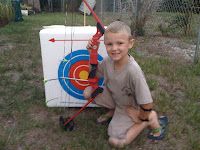
Gavin W. proud of his first shot!
The bow and target pictured right are a great combination for a young archer's first shot.  Gavin is holding a Matthew's Genesis bow, set at a 10 lb. draw weight, standing in front of a Drew Foam archery target made of open cell foam, which is covered with bulls-eye faced plastic for immediate use and weather proofing.


In a well rounded archery program the equipment will match the skill levels of the students. Having both open and closed cell targets, and alternative bag targets will allow for shooters with light and heavy equipment, at different skill levels have a safe and rewarding experience.


Mr. Gus

Monday, May 2, 2011

Springtime A Flurry of Shooting Competions

Brevard County Fair FITA Match
My writing has been kind of slow this spring because of my involvement in all of the shooting matches our local kids have been involved with.  But man, was it fun!


The State 4-H Matches - Locally we had about 50 kids participating in the Florida 4-H State Matches giving kids the opportunity to show their skills in archery, trap, skeet, rifle and black powder.  The state riffle match was held first, and Francis D. came in 6th place state wide in three-position air rifle, Intermediate Division.  Next was the state archery match at the new Easton-Newberry Sports Complex near Gainesville.  20 of our top archers competed in FITA, Field and 3-D competitions with most of our club placing or doing extremely well.  Our club is especially proud of Paul T., a 4-H Senior, who qualified for the National 4-H Invitational in June in the Sighted Compound Bow Division.  Our shotgunners did well in trap and skeet over in Bartow, Florida.  In this match, a child does not even place with a score less than 90 usually (of 100) broken clay targets!


Christina learning to
break both targets with one ball! 
I almost forgot to mention our muzzleloaders!  The season's local shooting culminated in the 4th Annual Brevard County Fair Archery Match.  63 shooters, shoulder to shoulder, competing against their peers for big, beautiful rosettes.  Our local club the Sharp-Eye Shooters took most of the awards, but all of the kids representing 11 different Florida counties did very well.


Noah and his Dad shooting together at
the state muzzle loading match.
What pleased me most with all of these events, was the level of safety, volunteer participation and sportsmanship displayed.  It was amazing.


Thanks to all who participated and to our commercial sponsors as well such as, but not limited to Brevard Archers, Action Gun and Archery, Hodgdon Powder, our local gun clubs in Mims and Palm Bay and the Florida 4-H Shooting Sports Program.

Tuesday, March 1, 2011

Practice Does NOT Make Perfect

Practicing is the act of rehearsing a skill or behavior over and over, or engaging in an activity again and again, for the purpose of improving or mastering it.  How many times have we heard, "Practice Makes Perfect"?  What if you are repeating behavior incorrectly over and over, does practice still make perfect?  I think not.  This might just be the most major piece of misinformation I was ever taught in school!
Used by permission from the creator, Mark Stivers.

If you have ever taken formal archery lessons, you'll know that there are certain steps to shooting an arrow out of a bow to make it not only fly true to hits its mark, but to have a safe and rewarding experience.  The physics of archery show us that if you execute each shot following each of the steps perfectly (or near), the arrow will go in the nearly exact same spot every time.  If you introduce a variable such as wind, or lose concentration so as to not take the shot perfectly,  the arrow will miss.  In the photo below, 100 students line up shoulder to shoulder at the 2009 National Archery In The Schools Program (NASP) World Tournament in Orlando, Florida.  In NASP, all of the equipment is identical except for color.  The difference measured in competition is the ability of the shooter, and how they have learned to follow each of the steps as near to perfect as possible in order to hit the 10 ring or bulls-eye at 10 or 15 meters. Perhaps we should say, "Perfect Practice Makes Perfect"?

I see my young archers and other shooting sports kids week after week practicing their skills, and while some are taking short cuts, not working on each step to perfection, others are following the steps, and their coaches advice, and it shows! 

Acknowledgements: Even though this article used archery as the main activity, almost any other activity could have been substituted of course.  Thanks Mark for the cartoon, and NASP for dedication to teaching archery to kids world wide! - Mr. Gus

Monday, December 21, 2009

Take Some Time To Reflect


"Take Some Time To Reflect" is becoming my new mantra for the next week or two at least. This past while has been a crazy one. In the last ten days my house was robbed, the car died, I took a weekend trip to Alabama, an 18 hour car ride to pick up our son from the Marines, an archery tournament, a group campfire and only 2 more days left of archery day camp, and my bathroom sink is leaking. Whew. Is it Christmas yet? What month is it?


Perhaps needless to say, it has been challenging for me to get into that good old holiday spirit.  The TV and radio media just make it worse, hearing about last minute Christmas shopping.  On the radio I heard the Carpenter's song, "There's no place like home for the holidays" which started to bring me back on track. Karen Carpenter's voice sooths my soul. Here's a reminder of how it goes...

Oh, there's no place like home for the holidays
'Cause no matter how far away you roam
If you long for the sunshine and a friendly gaze
For the holidays you can't beat home sweet home


In the 4-H program, we teach life skills and this would be a good one to reiterate - Reflection.  Look at the past day, week, month or year and reflect upon goals you set, or those you didn't but should have.  Reflect up on the important things in life, like your most important relationships, the ability to work, have a job or the opportunity to go outdoors and feel the breeze upon your face.  Reflect upon the things you do good, and the things you need to work on.  Whether your financial situation is tight or flush, you are alone or with family, everyone I know can gain from thoughtfully looking back to evaluate their situation.  I think I'll make a campfire over the holidays, enjoy it with my family and do some more of just that - reflect.
Photo Credit: Ginger Roberge.

Wednesday, December 2, 2009

Teachable Moments


A "teachable moment" is THE teaching opportunity, right at the instant it needs to be delivered. This teaching tool is applicable for any subject matter, students of any age. For example, on the archery range regarding finger guards - you can talk about them prior to shooting, "how important they are, blah blah blah", but why take away valuable shooting time with lecture. If the child shoots without finger guards, no harm will come other than potentially sore fingers. With no glove or finger tab you'll be able to see if the string is properly positioned, then after 10 shots or so, ask how the child's fingers are. If the shooter says they're kind of sore, then introduce him to the glove. They'll get it and never forget. The trademark of every effective educator is to devise and use teachable moments.

These teachable moments can't be done with most mandatory safety rules. There has to be some basic knowledge imparted so as to maintain order and range safety, but the more mundane - although very important topics can be taught one at a time, as the situation arises.

Final note. This is not a unique thought, but one of the many valuable tools imparted to all instructors in the 4-H shooting sports program.

Monday, November 30, 2009

You’ll Shoot Your Eye Out, Part 2 – Archery

…this doesn’t have to be true or even a threat this holiday season, if you’re considering getting your child or grandchild a bow and arrow. The best advice I can give you on buying your first bow is DO NOT buy a used bow from a neighbor, pawn shop or online, unless you know exactly what you’re getting and why. When you buy a bow for your youngster, you will need follow-up help. Ask yourself, will this vendor (online or otherwise) be able to provide me with expert advice after the sale? You see, bows and arrows are like shoes; they either fit or they don’t, and when they do fit, they are outgrown over a relatively short period. You can save a lot of money and heart ache, if you get your child fitted for a bow from someone who knows what they’re doing – a professional. The wrong size or improperly fitted bow may very likely cause your lad to become frustrated or discouraged and not enjoy shooting at all.

Things you need to know to buy your first bow. This is very simplified, but is a good enough explanation to help you make an intelligent decision. Notice I have not mentioned a compound or a traditional bow yet. I will.

Bow size: Your child has a wingspan, finger tip to finger tip with arms outstretched. Take that number in inches, and divide by 2.5 Example – Billy has a wingspan of 48 inches. 48 divided by 2.5 equals a draw length of 19.2 (or 20) inches. Always round up. A knowledgeable bowman will measure or ask for the draw length from the get-go. This measurement will affect what size bow you get, and the arrows you buy.

Bow Poundage: If a bow is a “20 pounds”, that means it requires 20 pounds of force to pull back. In my experience, the average eight year old child can draw back 15 to 25 pounds. In five shooting sessions, even over one week, that child’s strength and technique can increase to the point where even the lightest bow is becoming less challenging. Keep your new shooter challenged, but not overly so.

Compound verses traditional: Traditional bows include recurve and long bows. Compound bows have the wheels on each tip. Training Wheels! Some of us joke (tee hee hee). There is much controversy out there on which one to buy. Debates go on with this topic just as much as religion or politics. As a rule, in my humble opinion, traditional bows help reinforce better technique, where compound bows will help a kid hit the bulls-eye quicker. The reason this is so, is because most new compound bows come with sights similar to a gun, and the shooter no longer is using his/her instincts to aim the bow. These sights act as a crutch for some. Traditional bows will be useful over a broad draw length range, compound bows are not, BUT most of the major manufacturers are building bows that have an adjustable draw length over a range. Check your vendor for this. (Photo caption: the Genesis bow, by Matthews pictured is one of many fine bows to teach introductory archery in programs such as NASP. Even though it has wheels, it has the feel and characteristics of a traditional.)

As I mention in Part 1 of this series, get to know groups in your community who teach the sport and can help your child learn the fundamentals from the beginning. A good archery coach will immediately start teaching you and your shooter safety and the Nine, Ten or Eleven (depending on the organization) Steps to the 10 Ring.

Archery is more than just for fun. It can train that future bow hunter or next Olympian, but it also can potentially getting some kids in serious trouble. Adult supervision is always required for kids shooting bows, not just as a good precaution but in some cases, it is the law. Be Aware - modern bows and arrows, even the least expensive ones can easily kill a domestic pet or cause serious property damage. On the flip side again, shooting successfully requires a child to take multiple, specific steps in order, the exact same way, every time, time and time again. Similarly to learning to play a piano, the steps required in shooting can help a child scholastically, and build self confidence unlike many other activities. Make archery a family activity that you each can use to make memories for a lifetime.